What is Innovation?
In the context of ENVRIs, innovation means creating new or improved solutions, ranging from products and services to technologies, methods, and ways of doing business. It's not just about coming up with new ideas; it's also about using those ideas in practical situations to make a positive impact in the real world.
This approach aligns with the European Union's Open Innovation strategy, which encourages including people from various backgrounds—beyond just scientists and academics—in the innovation process. It supports working together with different partners, such as other research groups, businesses, government agencies, and communities, to bring new ideas and resources into the mix. By sharing knowledge and collaborating, we can tackle complex problems more effectively.
The main innovation focus areas that are currently relevant to the ENVRI community are:
- Development of new or improved products, technologies, or services, along with the innovative practices they entail.
- Knowledge and/or Technology Transfer for required solutions and the provision of services.
- Collaboration and Engagement with industry and other stakeholders.
Innovation Through a Structured Process
Innovation is not merely the act of inventing something new—it is a systematic process that transforms ideas into impactful solutions. In the context of environmental research infrastructures, innovation plays a critical role in addressing complex challenges such as climate change, biodiversity loss, and pollution.
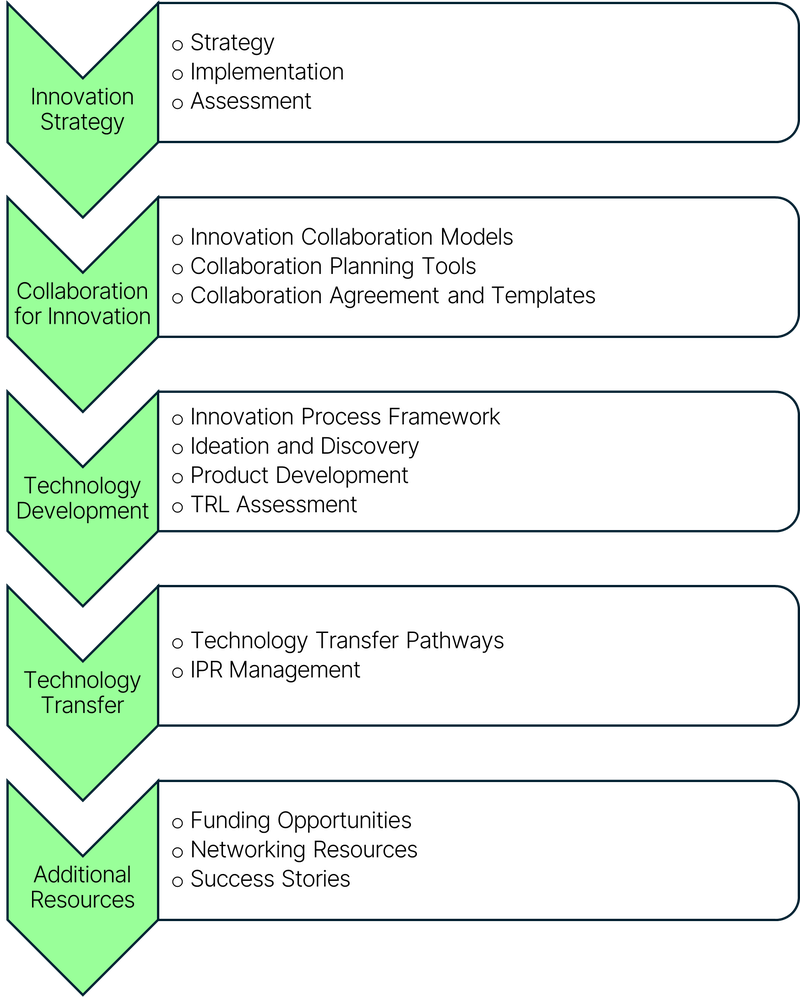
The diagram below presents the way that the ENVRI Innovation Hub is structured to guide innovation from conception to real-world application. It is important to note that the process is not linear but has more of an iterative approach.
Innovation Strategy
At the heart of the innovation process lies Innovation Strategy —the foundational phase that sets the direction for all subsequent activities. This phase is not about generating ideas but about creating the conditions for innovation to succeed by turning ambition into action. It ensures that innovation efforts are not ad hoc or isolated, but part of a coherent, long-term approach.
Collaboration for Innovation
Innovation thrives on collaboration. This phase emphasises working with diverse partners—research institutions, government agencies, industry, and civil society—to co-create solutions. Tools such as collaboration checklists and agreement templates help structure these partnerships. In ENVRIs, co-creation ensures that innovations are context-sensitive, inclusive, and supported by those who will use or be affected by them.
Technology Development
This is the starting point of innovation. It involves identifying unmet needs, emerging challenges, or opportunities for improvement. In environmental infrastructures, this might include recognising the need for more efficient water management. Once a promising idea is identified, it moves into development. This phase includes designing, prototyping, testing, and refining the solution. For example, a team might develop a new sensor for monitoring soil moisture. This stage is guided by Technology Readiness Assessments (TRL), risk evaluations, and iterative feedback loops to ensure the solution is viable and scalable.
Technology Transfer
To move from research to real-world impact, innovations must be transferred effectively. This involves managing intellectual property, defining ownership, and exploring commercialisation pathways such as licensing or spin-offs. In environmental contexts, this might mean transferring a new data visualisation tool to a national meteorological agency or licensing a pollution sensor to a private company.
Additional Resources
Final resources cover funding, networks, and success stories to scale innovations. Through programs and conferences, innovators share their results and build partnerships. They connect RIs, inspire others, and embed solutions in practice.